Thursday, December 9, 2010

Has tourism been a culprit in commodifying cultures and traditions?

Commodification locally?
Has tourism been a culprit in commodifying cultures and traditions? My answer is yes. Tourism has been a culprit in commodifying cultures and traditions. Tourism brings about tourists. Whenever you are on an overseas trip, do most of your friends or relatives ask you to get them a souvenir? I'm quite sure the answer is yes.

The definition of commodification according to www.dictionary.com is to turn into a commodity; make commercial. Thus, by commodifying a culture, means making it commercial. Examples are souvenirs being sold as part of a cultural tour. Using Brazil's Rio Carnival as an example, the tradition and culture such as the samba dance and the carnival balls are being commercialised and sold off as an event - Rio Carnival. This is an example of commodification.

Tourism, like globalisation is inevitable, you can control it but you are not able to stop it. Hence, there will be commodification occuring all the time. However, it is up to the nation's government to prevent the commodification from occuring as the government is able to control the impact tourism has on the country.


Changes brought about by tourism

Do you need this?
In my opinion, there is always two sides to a coin, thus, I will talk about the positive and the negative aspects of tourism which has brought about change in Brazil.

I will start of with the positive points. Tourism, naturally boosts a economy. Brazil which is the eight largest economy in the world, and is a fast growing economy at the same time. An increase in tourism will lead the country to have a better standard of living, which will benefit the locals. Tourism results in creation of jobs, which means a reduction of unemployment rate for Brazil. With the growth of tourism, more people have jobs, there will be less poverty in the country. As Brazil is a country that is rich in culture, a growth in tourism will lead to more tourists being educated by experiencing the culture in Brazil, it is also beneficial for the local community.

Now to move on to the negative aspect. As the catchphrase goes, "the rich gets richer and the poor gets poorer" this saying is used to discuss the economic inequality that occurs as a political effect of tourism. The difference in wealth between the locals and the tourist may generate apathy. Culturally, excessive visiting of the tribes may lead to an interruption in their daily activities as well as a dilution of culture.

I believe that when used correctly, tourism can be a powerful tool to boost a country' economy and improve the standard of living of the locals, however, when not monitored properly, can lead to side effects that are harmful for the entire nation.


http://www.ehow.com/facts_5244298_positive-negative-effects-tourism.html

Spot disney?

Themed environment in action
Have you seen this somewhere?
The disneyization of modern Brazil can be easily spotted. The growing trend towards social environment that are driven by a combination of consumption can be found in the society of Brazil. A large part of Brazil belong to football, which naturally also means that majority of the population watch sports - first form of consumption. Brazilians are also hardcore party-goers which leads to the opening of many clubs and bars - second form of consumption.


There is also an increased in themed environments in settings like hotels. The Rio Carnival which includes Carnival balls, certain balls in the hotel requires guests to dress up in costumes, which is a sign of themed environment. Many other festivals are also held in Brazil that has a themed environment to the whole event. Football may be used as a theme in any type of settings that is available, as football is famous in Brazil, it will attract many.


Merchandising in Brazil as a form of disneyization is straight forward. Selling football jerseys, footballing equipment under the Brazilan National Team's logo is disneyization at its best. Many other merchandise are also promoted and sold in this manner. Fans of footballing greats will flock to stores to purchase the items, a very good example of disneyization.


I will once again, use football as an example for performative labour. Footballers are paid huge some of money every year to train and play for their respective clubs as well as the national team. In this case, the employees are the footballers whereas the employers would be the football club. Everytime a goal is scored for the team, the player celebrates grandly - displaying a certain mood.


http://www.youtube.com/watch?v=QYyDgAWm_fE 

In the video, there is a clear theatrical feel to the whole celebration.

What is Brazil known for?

The squad that represented Brazil in the 2010 Fifa World Cup
Christ the Redeeme
What is Brazil known for? Hmm, i guess everyone's answer without a shadow of a doubt would be Football. Brazil are the only country that have played in every other tournament of the Fifa World Cup, they are also the only country that have won the Fifa World Cup 5 times.  Brazil have plenty of footballing talents plying their trade in different nation's football leagues, from names like Ronaldo to Kaka to Pele. There is no end to the list. Brazil is the only country in the world that has enjoyed such footballing success.


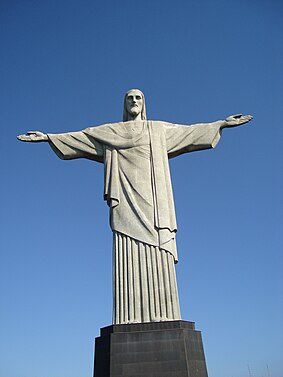
Next up, I'm quite sure will be the second to football, which Brazil is known for. Christ the Redeemer. It is a statue of Jesus Christ which is located in Rio de Janeiro. It is thought to be the second largest art decoration statue in the world, standing at an astonishing 39.6meters high and 30 meters wide, weighing 635 tonnes, is an architecture wonder. Christ the Redeemer, which is a symbol for Christianity, has now become an icon for Brazil as well as Rio.


http://en.wikipedia.org/wiki/Christ_the_Redeemer_%28statue%29


http://en.wikipedia.org/wiki/Brazil_national_football_team

Leisure Programmes in Brazil

Club in Brazil
There are plenty of leisure activities available in Brazil as it is a country widely known for its leisure activities. The vibrant nightlife in Brazil is well known worldwide as Brazilians generally like to party. The best nightlife activities can be found in cities such as Rio de Janeiro and Sao Paulo. Major clubs in Brazil do no start their main act until past midnight, which is a clear sign of Brazilian's passion for partying. Both Rio de Janeiro and Sao Paulo boasts international DJs in their very own clubs. In Rio, clubs playing live samba music are a hit. Most cities in Brazil have clubs as well as bars.


A very common sight in the streets of Brazil would be the locals playing soccer, everywhere on the streets. As Brazil is known as the country of football, naturally, the population are very very passionate in the sport. Kids can be seen playing football, with numerous different types of football grounds available, some even play on the streets itself!
KIds playing football in the streets of Rio de Janeiro


The Rio de Janeiro annual carnival is also a famous leisure activity in Brazil. The highlight of the event would be the Samba parade in Sambadromo. The Samba parade is a show which displays performances of various different samba schools in Brazil. In the city of carnival, Rio de Janeiro, there are no lack of Carnival balls during the period. This is a popular activity among Brazilians who love to dance. There are also street parties ongoing during the carnival, which is targeted at the Brazilians or even tourists who just wants to let their hair down and enjoy themselves.


Carnival balls!


http://www.worldtravelguide.net/brazil/nightlife
http://www.rio-carnival.net/rio_carnival/rio_carnival_programs.php

Mode of Education

The education system in Brazil is regulated by the Federal Government. The Federal Government is the one which defines all the guidelines for the education system in Brazil. The local government is in charge of state and education courses which is followed after the guidelines set by the Federal Government. The requirement for all Brazilian students is that they must attend school for a minimum of 9 years, however, schooling is usually inadequate in Brazil.


In elementary school, the Federal Council of Education states that students must take a core curriculum which includes Portugese, History, Geography, Science,  Mathematics and Arts and Physical Education. For year 6 onwards, two foreign languages, English and Spanish are made compulsory. The academic year of the school is established by the National Education Bases and Guidelines Law, at a minimum of 200 days.


In High School, at least 2,200 hours of coursework must be completed over the span of 3 years. Students must pass their elementary school before being able to enroll in High school. More subjects such as Portuguese literature, Philosophy and Sociology are being offered in High school.


http://en.wikipedia.org/wiki/Education_in_Brazil

Languages

A comic strip in Portuguese
The main language in Brazil is Portuguese, this is due to Brazil being a colony of Portugal. It is spoken by almost the entire population in Brazil. There are also minority languages in Brazil such as the Indigenous languages. An estimation of 210 languages are spoken in Brazil and among them are 80 indigenous languages. This shows the variety of races there is in Brazil and the multiethnic society that exist in the country. Language, in Brazil, is a key factor which contributes to the unity of the nation. This is because Portuguese is spoken by almost the entire population, in fact, 99.9% of the population, the exceptions being some groups of immigrants. The written language in Brazil differs significantly from the spoken language, Brazilian Portuguese, which are only used by a minority of the population. The grammar in the language is more complicated than languages like English as well as Spanish. These two languages are offered most of the time in schools as well as in private courses.

Indigenous People of Brazil

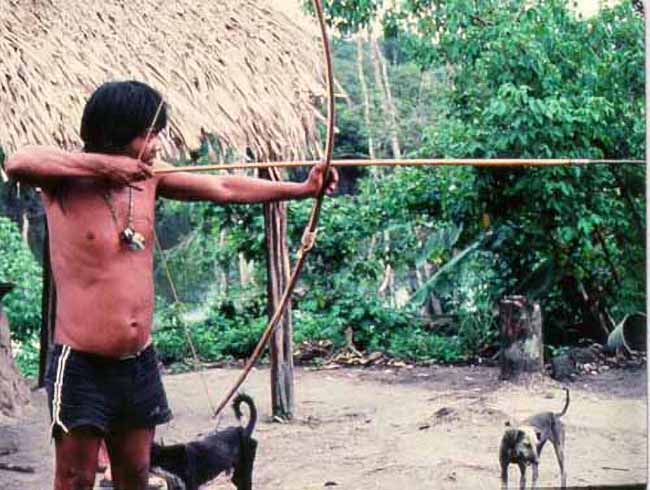
There are many indigenous people inhabiting in Brazil, I will pick two indigenous groups to discuss. First of all, the Piraha people of Brazil. They are a indigenous hunter-gatherers tribe of the amazon natives. Most of them live near the banks of the Maici River in Brazil's amazonas states. Their population stand at roughly 360, which is a sharp decrease from the past and their culture are on the verge of extinction. The Piraha people do not call themselves the Piraha, but instead, the Hi'aiti'ihi, when translated to english, means 'the straight ones'.


A Piraha Hunter
A view of the Maici River

Drawing of a Tupi Woman
The culture of the Piraha people, according to researchers, shows a simple family tree, no signs of social hierarchy and no leaders in the tribe. Instead of resorting to farming, the Piraha people have stuck to hunting as a main source of living, as well as bartering with traders from elsewhere. The Piraha people also have their own language which is called the Piraha language.


Secondly, I will talk about the Tupi people. The Tupi people were once the main ethnic group in the Indigenous group in Brazil. An interesting fact about the Tupi people is that in 1500, the population was estimated to be 1 million, roughly the population of Portugal. The Tupi people were further classified into tribes such as Tupiniquim, Tupinamba, Tabajar etc. The Tupi people practiced agriculture, planting corns, sweet potatoes and beans for a living.


In my opinion, the indigenous group in Brazil has been largely unaffected by globalisation. I believe that this is largely due to the fact they live far away from the main city, and there is no much connection with the indigenous people between the locals. This may be a good sign as the culture of the indigenous group is unchanged and remains original.


http://en.wikipedia.org/wiki/Tupi_people
http://en.wikipedia.org/wiki/Pirah%C3%A3_people


Tradition in Brazil

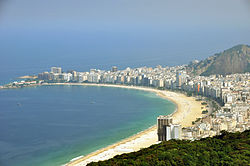
Scenic view of the Copacabana Beach!
A famous tradition known as Revillion, Ano Nove in Portugese,is the New Year celebration in Brazil. People travel from all over the world to celebrate the new year in Brazil. Why is New Year so special in Brazil you may wonder, it is the party that is going on that many are interested in. One popular location for such celebrations, is the beach. The best city to enjoy such celebration in Brazil will be, undoubtedly, Rio de Janeiro. The Copacabana beach which is located in Rio de Janeiro, is known worldwide and is crowded with party people during New Year's time. A tradition during the New Year celebration is the Brazilian festival, which involves plenty of music such as samba, frevo and forro which are mentioned earlier. Such celebrations which are conducted annually reflect a lot on the culture and tradition of Brazil.
Beach party going on!

The next tradition i will talk about which will occur in about 2 weeks time is the Christmas tradition of Brazil. The main religion in Brazil is the Roman Catholics, thus, a tradition is to create a Presepio. The word "Presepio" is dervied from the word "Presepium" which is the bed of straw upon which Jesus first slept in Bethlehem. This tradition was introduced in the 17th century and has been practiced up til now. Presepios these days are organised in December and often displayed in churches as well as homes of Roman Catholics. Large christmas trees with electronic lights are being displayed in cities like Brasilia, Sao Paolo and Rio de Janeiro which can be clearly seen against the night skies. There are also fireworks performances to welcome the New Year.


A christmas tree in Rio de Janeiro

Fireworks!

http://www.123newyear.com/newyear-traditions/new-year-traditions-brazil.html
http://www.thehistoryofchristmas.com/traditions/brazil.htm

Culture of Brazil

Brazil is a country that is very rich in culture as they are a multiethnic and multicultural society. With immigrants from all over the world, Italy, Germany, Spain and Japan just to name a few.


Here are some of the popular cultures in Brazil. Firstly, the cuisine. There are plenty of different cuisines available depending on which region of the country. This is largely due to the variety of immigrants they have
in the country. The national dish of the country, is Feijoada. It is a delicious stew of beans with beef and pork, which is a typical Portugese dish, showing the close linkage Brazil has to the Portugese culture.
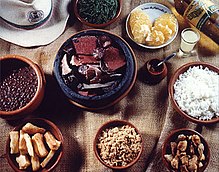


Fejioada! Looking good!
The frog like muiraquita

Secondly, the arts in Brazil. The oldest known Brazilian art is a cave painting that dates back to 13,000 BC which is a cave painting. Marajora which is a complicated piece of pottery, was found in Brazil. It belonged to cultures which were flourishing on an island called Marajo Island and around the region of Santeram. Statuettees and cult objects such as the small carved-stone amulet, Muiraquitas. Brazil has since continued with their passion for art and artists like Oscar Araripe, Beatriz Milhazes and Romero Britto are well known in our times.


Thirdly, will be the music culture in Brazil. The music culture in Brazil is very interesting due to the tools they make use to create it. Tools such as frying pans, small barrels with a membrane and a stick inside known as the cuicas as well as tambourines. Examples of popular music in regions of Brazil would be the forro from the northeast and the chlorinho, known as small tears, from Rio de Janeiro. However, in my opinion, the most popular form of music in Brazil, is the samba, and is recognised as a symbol for Brazil.


Samba performance


Last but not least, will be the sports in Brazil. Yes, the one you've been waiting for! There are too many popular sports in Brazil but I will only talk about two. FOOTBALL. The sport many link to the country, almost to the extent that they are inter-related. Kaka, Ronaldo and Ronaldinho are so of the famous names that are plying their trade currently. Pele is a footballing legend which has impressed many all over the world. The Brazilians have won at the FIFA world cup for 5 times!!Next would be martial arts available in Brazil. Martial arts such as the Capoeira and Brazilian jiu-jitsu are practiced widely in the world. I have even came across community centers here in Singapore offering the courses!




Capoeira dance

http://en.wikipedia.org/wiki/Culture_of_brazil

INTRODUCTION TO BRAZIL!

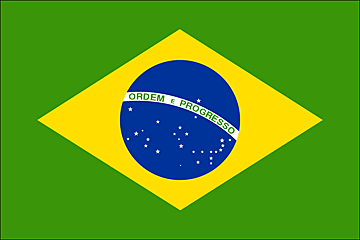
The country that I have chosen for this assignment  is Brazil which is located in the South America and is the largest country in the continent. It is also the fifth largest country. The capital of the country is Brazilia and the language that is mainly spoken in Brazil is Portuguese. The population in Brazil consist of various races and ethnicities, the diversity is so wide that almost everyone has a combination of European, African and indigenous ancestry. People from different nationalities arrived in Brazil in the late 19th and early 20th centuries played a vital part in creating the country’s multicultural and multiethnic society, similar to Singapore.


Don't mess with me
 Brazil used to be a colony of Portugal – resulting in most people speaking Portuguese. This also explains why many Brazilians are part Europeans. This resulted in the Brazilian culture being strongly influenced by the Portuguese culture. Other than the Portuguese language, the Portuguese also influenced the Brazilian religious wise, the Catholic religion, as well as architecture wise, using colonial architecture styles to build buildings. 


Streets of Brazil